
What Makes a Kitchen Truly Bespoke? A Practical Guide for Period Homes and Thoughtful Renovations
When people start planning a new kitchen, the word bespoke appears almost immediately.
It is used everywhere. On websites. In brochures. Across showrooms. In magazine features.
But the meaning is not always as clear as it should be.
Sometimes it describes a kitchen made entirely from scratch in a cabinetmaker’s workshop. Sometimes it means a standard system adapted neatly to suit a room. Sometimes it is simply a softer, more luxurious way of saying “made to measure”.
That matters, because not every home needs the same thing. And not every project benefits from the same level of complexity or cost.
A thoughtful kitchen project begins by understanding the room properly, and then deciding what level of design and making it truly needs. That is where the real value of bespoke lies. It is not in the label. It is in the fit between the solution and the home. This is especially true in period houses, listed buildings and older properties, where proportions, quirks and constraints rarely suit standard answers. Competitor messaging across the market leans heavily on “timeless”, “crafted” and “tailored”, but often explains the actual distinction less clearly.
A truly bespoke kitchen is designed for one specific space and one specific household.
That sounds obvious, but it is a meaningful distinction.
In a bespoke project, the cabinetry is not simply selected from a fixed menu of sizes and then arranged as neatly as possible. It is considered from first principles. The dimensions can change. The proportions can be refined. Architectural details can be picked up and echoed. Storage can respond to the way the room is actually used. Materials, finishes and fittings can be chosen because they suit the house, not because they sit within a predefined catalogue.
This is where workshop capability becomes important. A proper workshop does not just produce furniture. It allows the design to remain flexible long enough to solve the room well. If an old wall is out of square, if a chimney breast steals usable space, if a listed property calls for more sensitive detailing, or if the room needs to feel as though it has always belonged to the house, that is where bespoke earns its keep. Firms such as Humphrey Munson, Artichoke, Hunt and Woodchester all continue to foreground workshop making and hand-crafted furniture as a core part of their identity.
That said, bespoke is not automatically the right answer for every kitchen.
This is one of the things that is often missing from kitchen marketing.
There is a tendency to imply that more bespoke is always better. In reality, the best result is often the one that applies care and craftsmanship in the right places. Some homes genuinely need a made-from-scratch approach. Others need a more measured level of adaptation. The important thing is not to over-specify the project before the room has been properly understood.
A well-handled design process should help you see that clearly.
It should explain what is driving the decision. Is it the architecture of the house? The need for unusual dimensions? A desire for furniture-grade detail? The need to integrate the kitchen naturally into a wider renovation? Or simply the wish for something more thoughtful, durable and personal than a catalogue kitchen can offer?
If those questions are not being asked, the process may be more showroom-led than home-led.
That is one of the biggest weaknesses in the wider market. Many premium firms still begin by inviting clients into a beautifully curated showroom and building the early experience around aspiration. Showrooms can be useful, of course. They help with finish quality, colour, ironmongery and detail. But they are not the room. They cannot reveal how the morning light moves across your floor, how tight a walkway feels when two people are cooking together, or where a beautiful idea on paper will become awkward in daily life. Martin Moore, Tom Howley and Plain English all place significant emphasis on consultations and showroom experience; Bath Bespoke is one of the clearer examples of bringing the process into the home earlier.
For that reason, the most sensible place to begin is not a showroom display but the home itself.
Good bespoke design starts in context.
It starts by standing in the room and asking practical questions. What works already? What does not? Where are the constraints? What feels mean, awkward or unresolved? Which original features deserve respect? Which details should the kitchen pick up from the rest of the house? And just as importantly, how do you want the room to feel when the work is done?
That last point matters because the best bespoke kitchens are not just clever. They are calm.
They do not feel over-designed. They do not try too hard. They sit naturally in the house, support everyday life and make the room feel more settled than it did before. In period homes, that often means restraint. Proportion matters more than novelty. Materials matter more than trends. Quiet details matter more than attention-seeking ones. That is why the current dominance of “timeless”, “heritage” and “crafted” language in the market is not surprising. The real question is whether those values are being translated honestly into the finished work and the design process that leads to it.
A good bespoke kitchen should also feel convincing behind the paint finish.
This is where practical craftsmanship matters. Joinery quality. Material selection. How drawers are built. How doors sit. How awkward spaces are resolved. How installation is handled. How the whole thing settles into the room. These are not glamorous subjects compared with polished photography, but they are the difference between a kitchen that merely looks expensive and one that genuinely feels right after years of use.
That is also why trusted craftsman relationships matter so much. When the person designing, making and fitting the work remains closely connected to the project, there is usually more continuity, more accountability and fewer compromises between idea and outcome.
So when is bespoke truly appropriate?
Usually when the room itself demands it, or when the homeowner wants something that cannot be achieved well through standard means.
That may be because the house is old and irregular. Because the proportions need careful control. Because the kitchen has to relate to original architecture. Because the project includes furniture, pantry rooms or fitted joinery elsewhere. Or simply because the goal is a more resolved, furniture-led result that will last properly and belong to the home.
And when is it not necessary?
When the room is straightforward, the requirements are simple and another route will do the job well. There is no weakness in saying that. In fact, it is often a sign that the designer is thinking clearly.
That is ultimately what homeowners need more of: not more claims, but better guidance.
If you are considering a new kitchen, the most useful first step is not asking whether you want bespoke. It is asking what your home actually needs.
Once that is clear, the right answer tends to become much easier to see.
And if bespoke is the right answer, it should not feel like a grand label. It should simply feel like the most sensible, well-made and well-considered way to solve the room in front of you.
A home design visit is often the best place to start that process: in the actual space, with real dimensions, real light and a practical conversation about what is genuinely worth doing. That is where clarity begins.
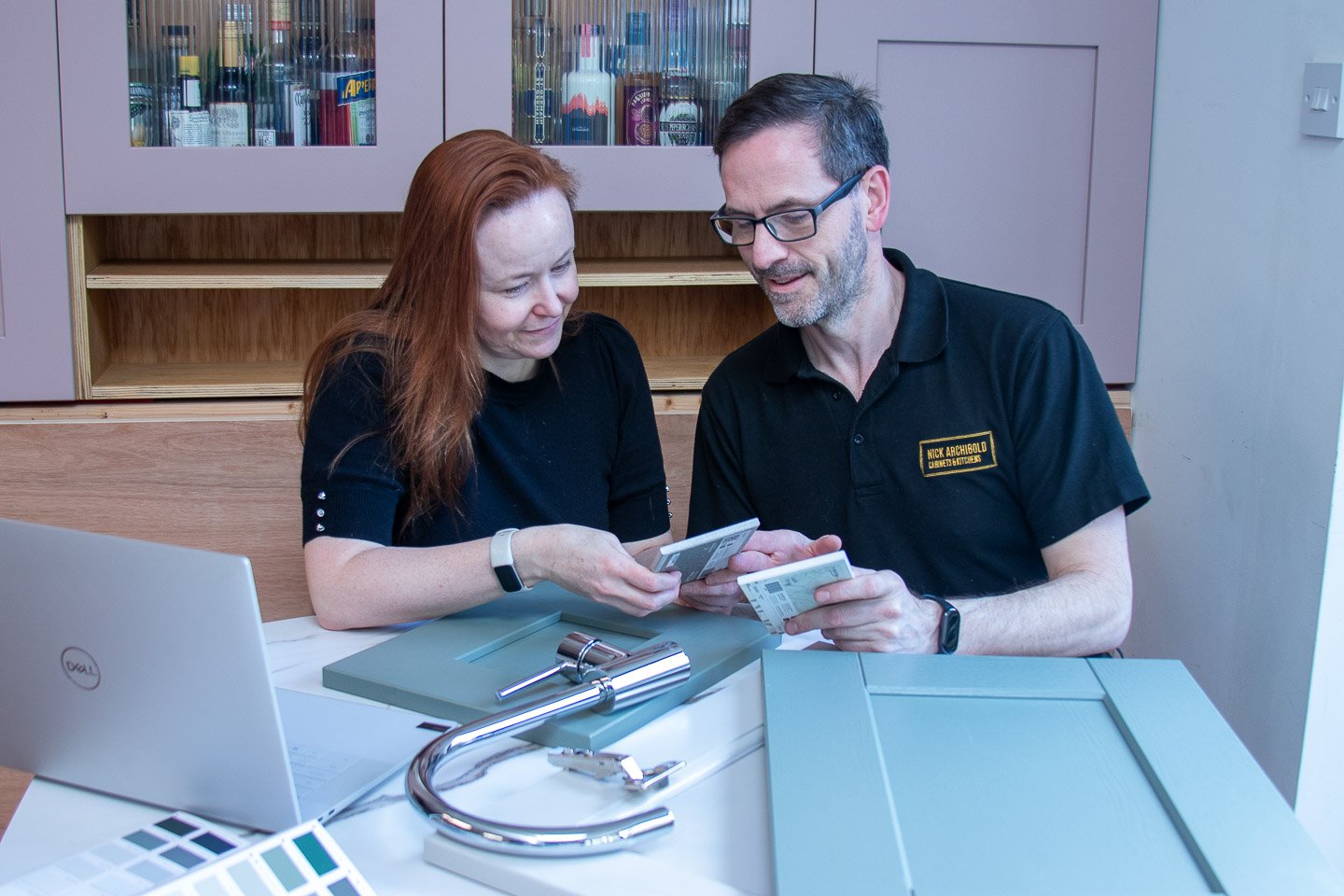
A relaxed Home Design Visit is the ideal starting point for your project
