
What “Custom Kitchen” Really Means - And How to Get It Right in Your Home
“Custom kitchen” has become one of the most widely used phrases in the industry.
You’ll see it everywhere—on websites, in brochures, across showroom displays.
But when you look a little closer, it’s not always clear what it actually means.
For some, it’s a fully bespoke kitchen made from scratch.
For others, it’s a standard system with a few choices applied.
And for most homeowners, that lack of clarity makes the process harder than it needs to be.
Why the Definition Matters
At first glance, the distinction might seem technical.
But in practice, it shapes everything:
How well the kitchen fits your space
How it functions day to day
How long it lasts
And ultimately, whether it feels considered—or compromised
Understanding what custom really involves is the first step toward making the right decision.
The Spectrum: From Standard to Fully Bespoke
Most kitchens sit somewhere along a spectrum.
At one end, you have fully standardised systems:
Fixed cabinet sizes
Limited material choices
Layouts designed to fit the system, rather than the room
At the other, fully bespoke kitchens:
Built entirely from scratch
Every dimension and detail tailored
Designed and made specifically for one space
In between sits what most companies describe as “custom”.
But this middle ground varies significantly.
Where “Custom” Often Falls Short
In many cases, a custom kitchen is still built around a standard framework.
Cabinet sizes are fixed.
Internal construction is pre-determined.
Options are selected rather than created.
The result can still look good—but it may not fully resolve the space:
Awkward gaps are filled with filler panels
Proportions are adjusted visually rather than structurally
Storage works—but not quite as well as it could
None of this is necessarily wrong. But it’s rarely explained clearly.
And that’s where expectations can drift away from reality.
What Thoughtful Customisation Should Look Like
A well-considered custom kitchen takes a different approach.
It starts with the space—not the system.
That means asking:
What does this room actually need?
Where are the pressure points?
How is the space used, day to day?
From there, the cabinetry and layout are adapted accordingly.
That might include:
Adjusting cabinet widths to avoid wasted space
Refining proportions so everything feels balanced
Integrating bespoke elements where they make a real difference
The key is that the system works for the space—not the other way around.
Why the Starting Point Changes Everything
Most kitchen projects begin in a showroom.
And while showrooms are useful for seeing materials and finishes, they’re not where the most important decisions should be made.
Because the reality of your kitchen is specific:
The way light enters the room
The exact dimensions and constraints
How you move through the space
What you store, and how often you use it
These are not abstract considerations. They’re practical ones.
And they’re best understood in the place where they exist—your home.
Designing in Context
When design starts in your home, the process becomes more grounded.
You can see:
Where a standard cabinet size will create an awkward compromise
Where a small adjustment will significantly improve usability
Which elements are worth investing in—and which are not
Often, this leads to a more balanced outcome:
Some parts remain standard
Others are adapted
A few are made completely bespoke
But every decision is made for a reason.
The Role of Craft
There’s also a practical side to customisation that’s often overlooked.
It’s not just about how things look—it’s about how they’re made.
Cabinetry that has been thoughtfully constructed should:
Handle daily use without strain
Support weight where needed
Age well over time
Be repairable, not disposable
This is where workshop experience becomes important.
Understanding materials, construction methods, and long-term performance adds a layer of depth that goes beyond surface-level design.
Avoiding Over-Specification
One of the less obvious risks in this part of the market is over-specification.
It’s easy to assume that more bespoke automatically means better.
But in reality, the best kitchens are often a balance:
Bespoke where it matters
Standard where it works perfectly well
This approach keeps the project grounded—both practically and financially.
And it ensures that effort and budget are focused where they have the greatest impact.
A More Considered Way Forward
For most people, the challenge isn’t a lack of options.
It’s the opposite.
There’s a vast range of choices, all presented as the right solution.
What’s often missing is guidance:
Clear explanation
Honest boundaries
Practical thinking
A calmer, more considered approach helps cut through that noise.
It brings the focus back to the space itself—and what it genuinely needs.
Where to Begin
If you’re considering a new kitchen, or improving your existing one, it’s worth stepping back from the terminology.
Instead of asking:
“Do we want a custom kitchen?”
A more useful question is:
“What does our space actually need?”
From there, the right level of customisation becomes much clearer.
And the end result is far more likely to feel coherent, practical, and properly resolved.
A well-designed kitchen doesn’t begin with a label. It begins with understanding the space it sits within.
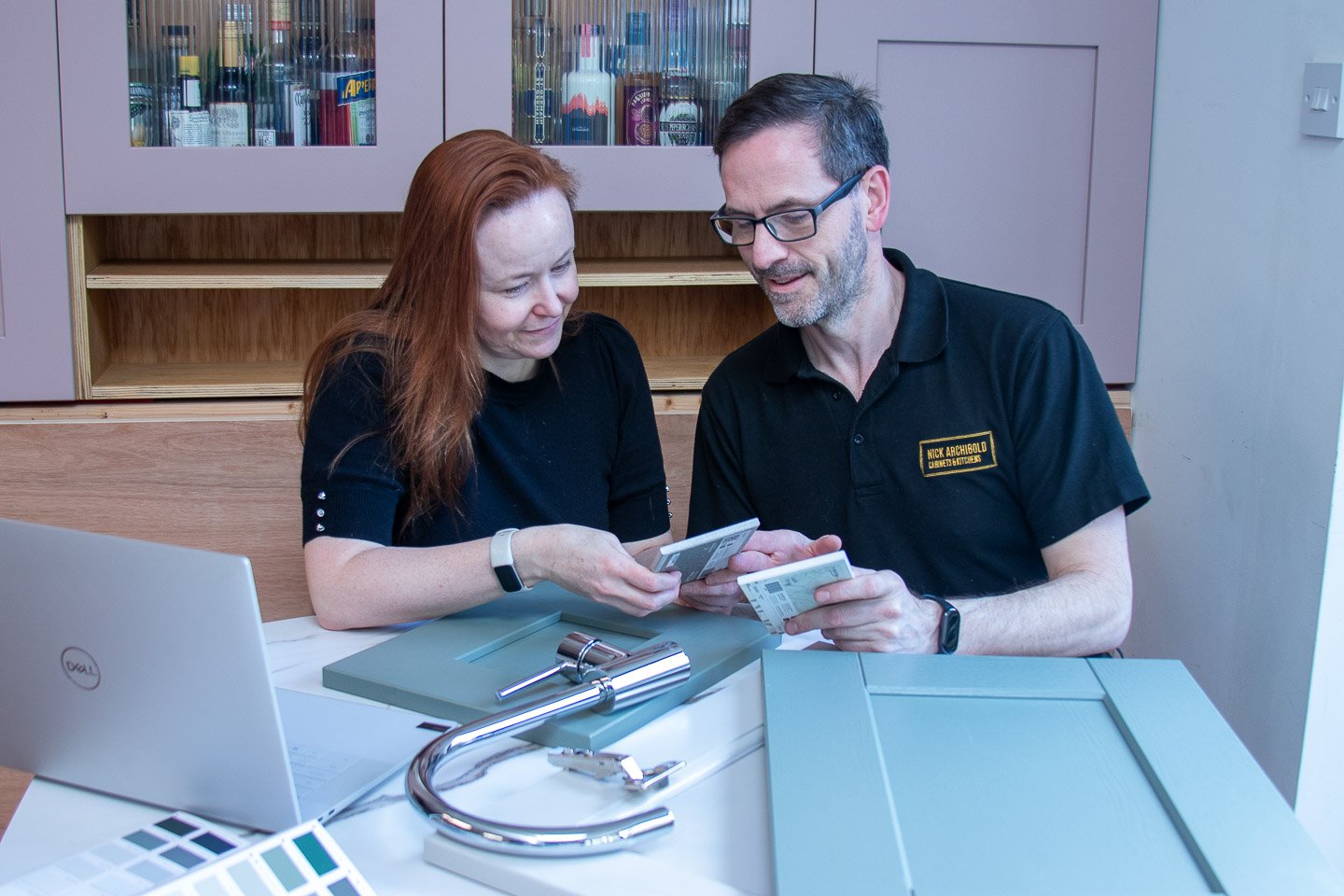
A relaxed Home Design Visit is a great way to start your kitchen journey
