
Don’t Replace Your Kitchen—Until You Understand What It Really Needs
There’s a moment most people reach with their kitchen.
It might be when a drawer starts sticking. Or when the doors feel tired. Or when the space simply no longer works for how you live.
And the instinct is often the same:
“We probably need a new kitchen.”
But in many cases, that isn’t quite true.
What’s actually needed is something more considered—and often far less disruptive.
The Problem With Starting at the Showroom

Perfect layouts - perfect lighting - perfect conditions. Not real life
Most kitchen journeys begin in a showroom.
Rows of beautifully lit displays. Perfectly styled cabinetry. Clean lines and ideal proportions.
It’s inspiring—but it’s also abstract.
Because none of it reflects:
Your room
Your light
Your layout
Your daily routine
So decisions are made in isolation. And before long, the project becomes about choosing a new kitchen, rather than understanding what your current one could become.
Not Every Kitchen Needs Replacing
There are broadly three routes a kitchen project can take:
1. A Refresh
Keeping the existing structure, while improving how it looks and feels.
New doors, updated worktops, luxury sink & tap, improved finishes.
2. A Custom Kitchen
Retaining new standard cabinetry, but adapting and refining it to suit your space more precisely and personally.
3. A Fully Bespoke Kitchen
Built from scratch. Every dimension, material and detail considered and made specifically for your home.
The challenge is that many companies only offer one of these routes. So naturally, that’s what they recommend.
But the right answer depends entirely on your space—and how you use it.
The Cost of Getting That Decision Wrong
Replacing a kitchen unnecessarily brings:
Higher cost
Greater disruption
More waste
But trying to refresh a kitchen that fundamentally doesn’t work can be just as frustrating.
The key is not choosing the biggest solution—but the right one.
And that requires a different starting point.
Designing Around Your Actual Space
A more effective approach begins in your home.
Not after decisions have been made—but at the very beginning.
Standing in the space, you can see things that no showroom can reveal:
How natural light moves through the room
Where circulation works—or doesn’t
Which elements are worth keeping
Where small changes would make a disproportionate difference
Often, it becomes clear quite quickly:
Some kitchens only need refining
Others need rethinking
A few genuinely need replacing
But that clarity only comes from context.
The Quiet Value of a Thoughtful Refresh
A well-considered refresh can be transformative.
Not because everything is new—but because the right elements are improved.
That might include:
Replacing worn or dated doors
Introducing a more durable and visually balanced work surface
Adjusting details that improve daily use
Done properly, it respects what’s already working—while resolving what isn’t.
And importantly, it avoids unnecessary upheaval.
When Replacement Is the Right Answer
There are, of course, times when a full replacement makes sense.
If the layout restricts how you move through the space.
If storage is fundamentally inadequate.
If the cabinetry itself has reached the end of its life.
In those cases, starting again allows for a more coherent and lasting solution.
But even then, the thinking should remain grounded:
How will the space actually be used?
What needs to last 10–15 years, not just look good today?
Which materials will age well in a working kitchen?
The Difference Craft Makes
At the higher end of the market, there’s a tendency to focus heavily on appearance.
Beautiful finishes. Clean lines. Carefully curated colours.
But what often gets overlooked is how a kitchen is built—and how it performs over time.
Well-made cabinetry, whether custom or fully bespoke, should:
Feel solid and dependable
Support weight without strain
Use materials that improve with age
Be designed with practical use in mind
This is where workshop experience matters.
Not just in how things look—but in how they function, quietly, every day.
A More Measured Way to Approach the Process
For most people, replacing or improving a kitchen is not something they do often.
It’s a significant decision. And it should feel considered—not rushed.
A calmer process tends to produce better outcomes:
Understanding the space before proposing solutions
Exploring options without pressure
Being clear about what’s necessary—and what isn’t
That approach doesn’t rely on urgency or promotion.
It relies on clarity.
Where to Start
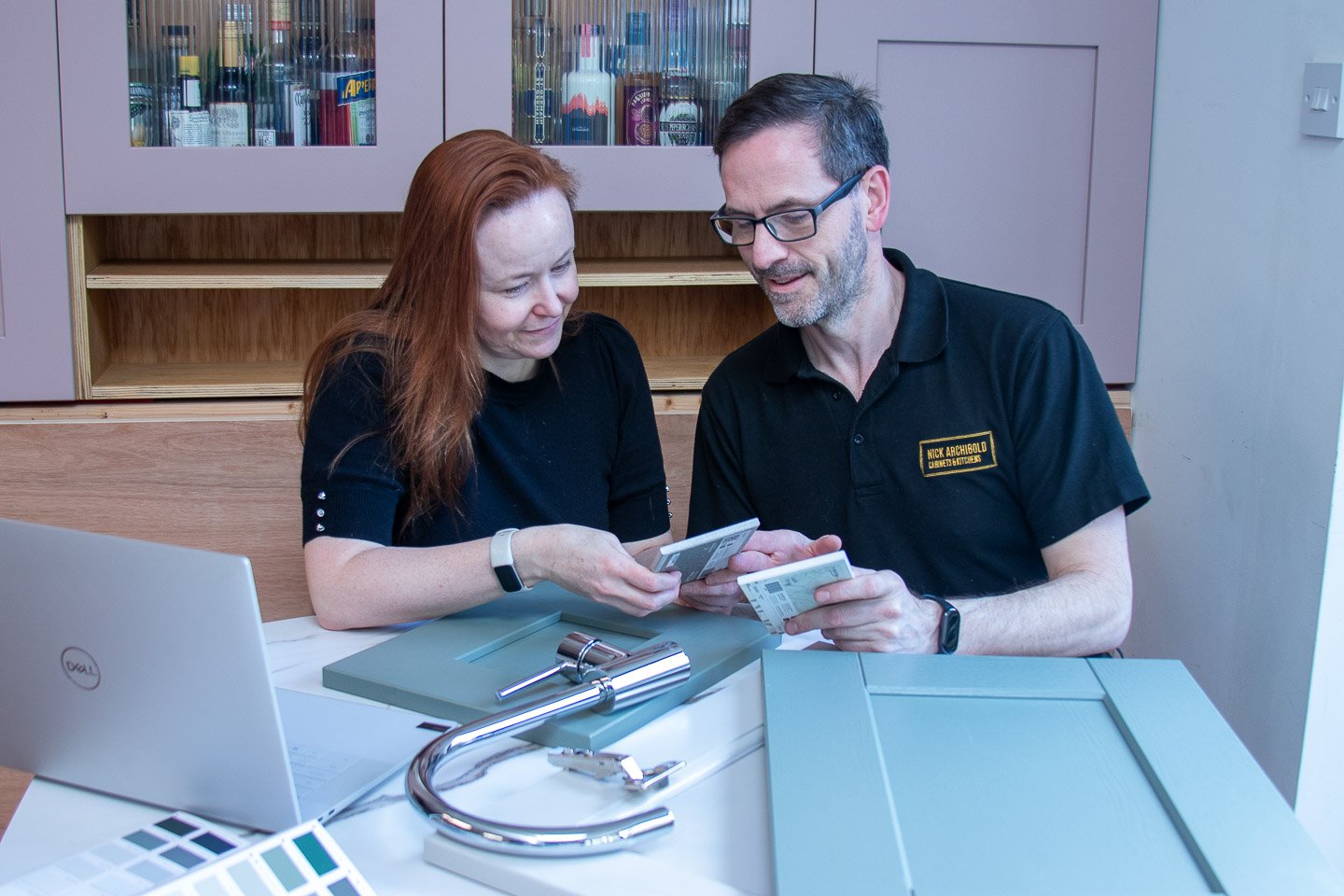
A relaxed Home Design Visit is a great place to start your journey
If you’re considering changing your kitchen, the most useful first step is not choosing a style.
It’s understanding your space.
What works.
What doesn’t.
What could be improved without starting again.
Once that’s clear, the right path—refresh, refine or replace—becomes much easier to see.
And the end result is far more likely to feel considered, balanced, and right for your home.
A thoughtful kitchen doesn’t begin in a showroom. It begins in the space where it will actually be used.
