
Custom Kitchens Designed in Your Home: A Better Way to Personalise Your Kitchen
Choosing a new kitchen should feel exciting. But for many homeowners, it quickly becomes confusing.
You start with a simple idea — to improve the kitchen. Then suddenly there are door ranges, cabinet colours, worktop materials, handle choices, storage systems, appliances, lighting plans and showroom displays all competing for attention.
Before long, the project can start to feel less like designing a home and more like navigating a catalogue.
That is one reason custom kitchens have become so popular. They offer a more personal approach than a standard showroom kitchen, without always needing the cost or complexity of a fully handmade bespoke kitchen.
But “custom” and “personalised” are words that are now used widely across the kitchen industry. Sometimes they mean a kitchen genuinely designed around your home. Sometimes they simply mean choosing from a long list of standard options.
The difference matters.

What Is a Custom Kitchen?
A custom kitchen sits between a standard off-the-shelf kitchen and a fully bespoke handmade kitchen.
It usually begins with high-quality cabinetry, doors and components from proven British suppliers. These give the project a reliable foundation: well-made cabinets, durable finishes, good hardware and a broad choice of styles.
The customisation comes in how those elements are selected, combined, adapted and detailed.
That might include the layout, the door style, the colour palette, the worktops, the handles, the storage, the lighting, the appliances and the way the kitchen connects with the rest of the room.
It may also include specially made pieces, such as a bespoke island, dresser, pantry cupboard, shelving, seating area or awkward-space solution.
In other words, a custom kitchen is not simply about choosing a colour. It is about creating a kitchen that fits your home, your routines and your priorities.
Why Catalogue Choice Is Not the Same as Personalisation
Many kitchen companies now offer hundreds of finishes and combinations. That can be useful, but it can also become overwhelming.
More choice does not automatically mean better design.
A kitchen can be highly specified and still feel wrong if it has not been planned around the room itself. A beautiful door sample may look completely different in your own light. A fashionable colour may not suit the floor, the architecture or the surrounding rooms. A clever storage feature may be unnecessary if it does not match the way you cook or live.
True personalisation is not about adding more options.
It is about making better decisions.
That means asking practical questions early:
How do you use the kitchen each day?
Where does clutter gather?
What currently frustrates you?
Which parts of the existing kitchen work well?
Do you need more storage, or simply better storage?
Is the layout wrong, or are the details letting it down?
Would a full replacement improve the space, or would a more targeted approach be wiser?
These are difficult questions to answer properly in a showroom, because the showroom is not your home.
Why Good Kitchen Design Should Start at Home
A kitchen is shaped by the room around it.
The light, the proportions, the doorways, the windows, the floor, the existing services and the way your family moves through the space all affect the final design.
That is why designing in your home makes such a difference.
When samples are brought into the actual room, decisions become easier. You can see how a painted door sits against the wall colour. You can compare worktop materials in your own light. You can understand whether a darker tone feels rich and grounded, or simply too heavy. You can test whether a handle, timber, stone or painted finish feels right in context.
This kind of design conversation is more grounded than choosing from a display.
It also helps avoid expensive mistakes.
A kitchen is not just a set of products. It is a working room. It has to feel right at breakfast on a Monday morning, not just under perfect showroom lighting.
Where Customisation Adds the Most Value
Thoughtful customisation is most valuable where it solves real problems.
That might be an island designed to suit the exact proportions of the room. It might be a dresser that gives a plain wall purpose and character. It might be a pantry cupboard that makes food storage easier. It might be a run of cabinetry adjusted to deal with an awkward alcove, an uneven wall or a low ceiling.
These details are often where a kitchen moves from looking acceptable to feeling properly resolved.
They are also where workshop capability matters.
A purely catalogue-led kitchen is limited by the available system. A fully bespoke kitchen can solve almost anything, but may not always be necessary. A custom kitchen with selected bespoke elements offers a practical middle ground.
You use reliable, high-quality cabinetry where it makes sense, and bring in handmade or modified pieces where they genuinely improve the result.
That is often the most balanced approach.

With a fully-equipped workshop, there are no limits
The Difference Between Refresh, Custom and Bespoke
One of the most common sources of confusion is knowing how far to go.
Some kitchens do not need replacing. They need refreshing. New doors, worktops, handles, storage improvements or a few carefully chosen changes may be enough to transform the room.
Other kitchens need a more complete redesign, but not necessarily a fully handmade build. This is where a custom kitchen can work beautifully.
Then there are homes where a fully bespoke kitchen is the right answer — particularly where the architecture is unusual, the requirements are highly specific, or the kitchen needs to be built as individual furniture rather than assembled from standard cabinetry.
The important thing is not to decide too early.
A good design process should help you understand the difference before committing to a route.
A Simpler Way to Begin
The best kitchen projects usually start with clarity, not with a catalogue.
Before choosing a door style or worktop, it helps to understand the room, the problems and the opportunities. From there, the right level of intervention becomes much easier to see.
Sometimes that means a refresh.
Sometimes it means a custom kitchen.
Sometimes it means fully bespoke cabinetry.
The value lies in choosing the right approach for your home — not the most expensive one, or the one a showroom happens to be promoting.
That is why my custom kitchen process starts with a home design visit. I bring real samples into your space, look carefully at how the room works, and help you make decisions in context.
The aim is simple: a kitchen that feels personal, practical and properly considered.
Not a catalogue kitchen squeezed into your home.
A kitchen designed around it.
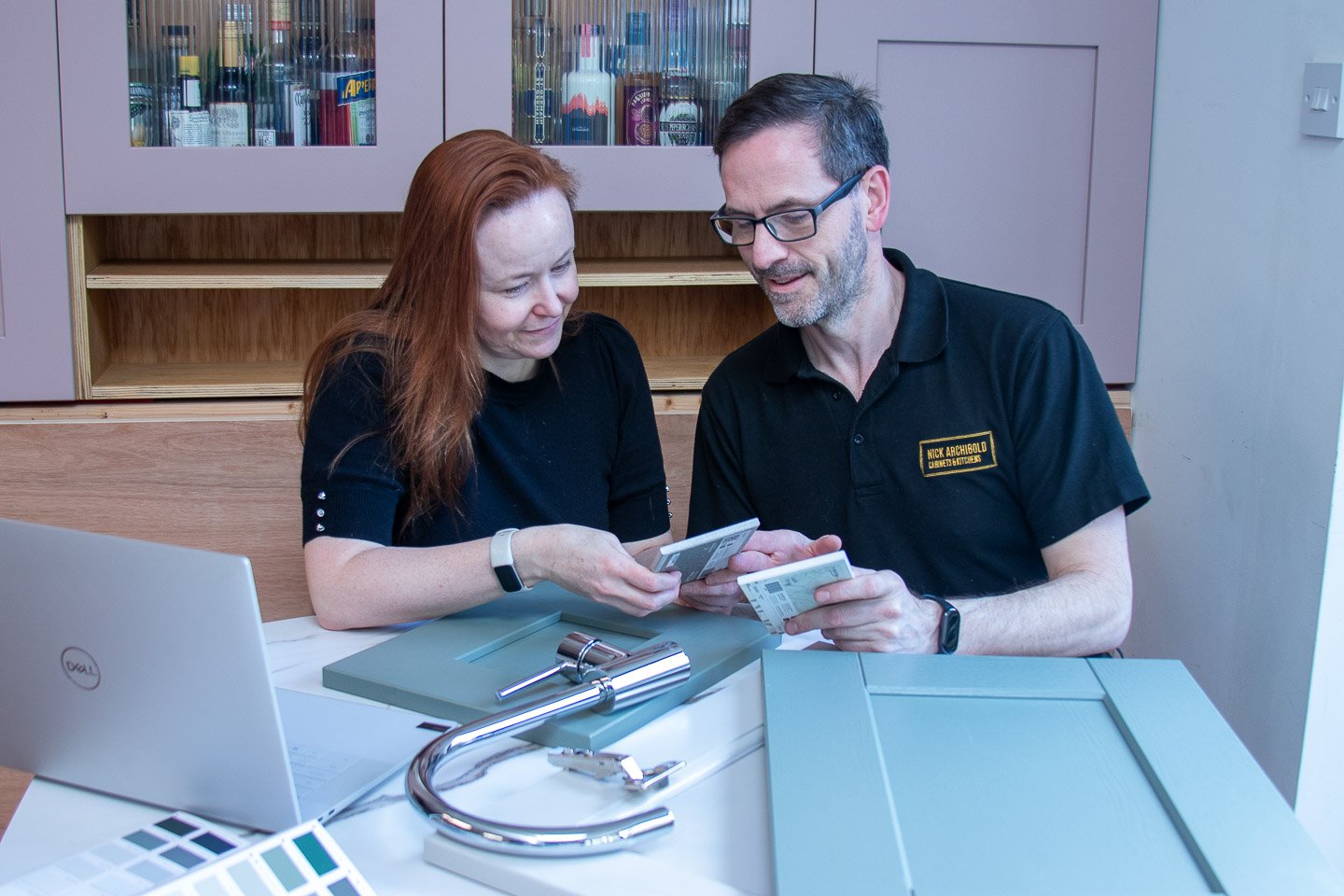
A home visit is a great way to start your kitchen journey
